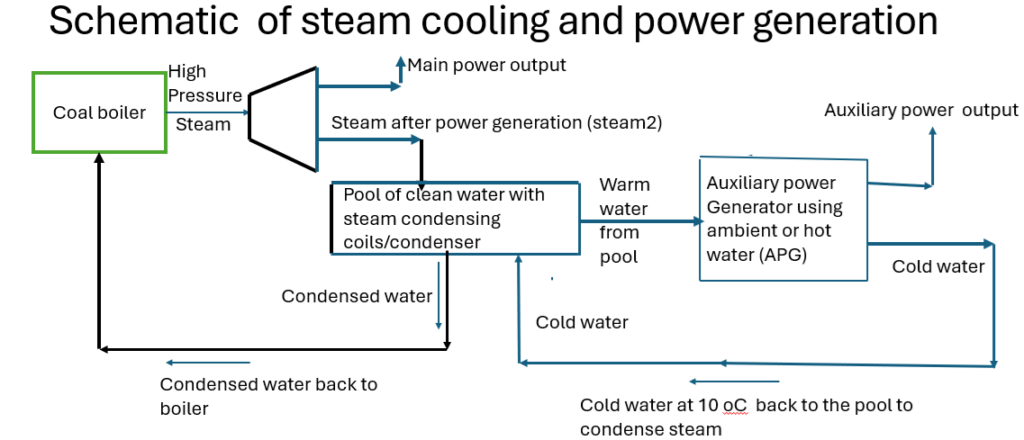
F ig. A Schematic of the steam cooling and auxiliary power generation with a fixed amount of water (the new technology). The schematic does not show the conventional intermediary steps between condensed water and coal boiler.
II.2. Method steps: These three objectives are accomplished using the following steps.1. Cool the exhaust steam, steam2 [after the main power generation, Fig.A] in a coal power plant in a cooling-condenser that contains a fixed mass of clean water and without any energy from the main power output or any external power source; steam2 enters heat exchanger coil immersed in the condenser water, not shown in Fig. A.
2. To return the condensed water from (1) (~ at 10 oC above the ambient) to the boiler or a pre-boiler system so that the boiler practically runs with a constant mass of water except for small losses of steam at turbine expansion or at any other leakage points.
3. Using the hot water from the cooling condenser [carrying the heat rejected by steam 2 at the water tank/condenser] generate auxiliary power in the auxiliary power generator (APG-Fig. A) that is based on a single hybrid ambient power engine (SHAPE) with the help of the technology of ref.A7 using the schemes shown in Fig. 1 and Fig.2; the warm water gets cooled in the process.
4. To return the outgoing cold water from the APG unit in Fig. A (step #3) at about 5 to 10 oC to the cooling condenser so that it keeps cooling the fixed amount of water in the condenser which receives heat from the incoming low-pressure steam2 and the steam is thus cooled continuously.
5. Thus, we keep cooling steam2 with zero input energy from an external source, and with no use of recirculating water, wet cooling, dry cooling or hybrid cooling, and generate auxiliary power using the (waste) heat rejected by steam2 at the condenser.
Project Title: A Novel Technology Development for Steam Cooling, Water Conservation, and Auxiliary Power Generation
In fossil fuel and nuclear power plants power is generated by producing high pressure steam using very clean water in a boiler and rotating a turbine connected with an alternator with the pressurized steam and condensing the resulting low-pressure steam into clean water which is returned to the boiler for its protection and cost. Wet-cooling (WC), once through cooling (OTC), dry cooling(DC) and hybrid cooling (HC) methods are employed to condense the steam. The water consumption and uses with WC and OTC are significant and the OTC & WC causes serious environmental and aquatic ecosystem damages. DC causes efficiency losses that increases in hot weather. As a consequence while both fossil fuel and nuclear power are on increasing demand their sustainability is at stake. In this project we aim to develop a novel technology that cost-effectively address these issues (large water consumption, ecosystem damages and efficiency degradation).
Intellectual Merit
This project involves (I) use of a single condenser containing a fixed amount of water to condense the low-pressure steam into water continuously without any cooling tower; (II) it pioneers a new thermodynamic pathway for converting waste heat of low-pressure steam carried by the condenser water into a usable clean auxiliary power very cost-effectively and in the process cooling the warm water of the condenser so that it can condense freshly the incoming steam again so that the cycle can repeat. Intellectual contributions include: 1. First demonstration of continuous cooling of steam with a fixed amount of water in a condenser; 2. generation of sufficient auxiliary power from the waste heat of steam using a patented hybrid power cycle that consists of a refrigeration cycle and a power cycle and using the same fixed amount of a cryogenic working fluid. (3) Increases efficiency significantly. 4. Cooling the warm water of condenser to cool and condense the incoming steam in cyclic process without using any external power or water. 5. Conservation of natural water and aquatic ecosystem; 6. Ensuring sustainability of fossil fuel and nuclear power generation in all places irrespective of water availability and drought. 7. No discharge of water. 8. Prototyping a sustainable system to demonstrate these features and validate the technology. 9. Integration of comprehensive technical feasibility analysis, risk mitigation, & a strong graduate student mentoring plan. 10. Data collection, modeling & system design for integration of sustainable power generation system for some power plants in the USA. 11. Training of manpower.
Broader Impacts
X. Broader Impacts:
(1) It will sustain fossil fuel and nuclear power generation in areas with acute water shortages, during summer time and drought by reducing stress on water requirement (both withdrawal and consumption) and providing cold water from APG to cool the low-pressure steam in the condenser in closed cycle with a fixed amount of water. (2) It will boost significantly the power generation by efficiently utilizing the waste heat of steam after the main power generation and also from waste heat in industries with good efficiencies (49-68%). (3) It is expected to significantly reduce the cost of installation and operation and cut down the unit cost of electricity and emission per kWh generation. (4) The development of APG generator is expected to open a new front of clean power generation by using ambient heat of water in lakes, river etc. and a new methodology to boost efficiency of power generation using concentrated solar energy where high temperature heat transfer fluids have some unsolved challenges [A13-A15]. (5) Employing some of the technology inventions (A7, A8, A9, A10, A11 and A12) and using part of the auxiliary power generated as proposed in this project one should be able to capture significant amount of CO2 and toxic components at low costs while still boosting the efficiency of the fossil power plants and thus making them more sustainable and cleaner. (6) The equipment can be integrated to the existing and future thermal power plants.
References for APG/SHAPE Auxiliary Power Generator (Fig. A) in the Proposal Description:
Al. Knowlen,C.,A. Herztbery, and A.T Mattich. 1994. Cryogenic Automotive Propulsion. AIAA Paper No. 94- 4224: 29′h I.E.C.E.E.
A2. Knowlen, C., A.T. Mattich, A.P. Bruckner, and A Hertzberg. 1998. High Efficiency Energy Conversion System for Liquid Nitrogen Automobiles. SAE Paper No. 981898.Warrendale, Pa.: SAE.
A3.Knowlen,C.,A.T Mattick, A. Hertzberg, and A.P Bruckner. 1999.Ultra—Low Emission Liquid Nitrogen Automobile. SAE Paper No. 992932.Warrendale, Pa.: SAE.
A4.Knowlen,C.,J. Williamss, A.T. Mattich, H. Deparis, and A. Hertzberg. 1997. Quasi-Isothermal Expansion Engines for Liquid N2 Automotive Propulsion. SAE Paper No. 972649.Warrendale, Pa.: SAE.
A5. AS. Carlos A. Ordonez,(ii) Mitty C. Plummer, Richard F. sciences us/dico/d/sustainable-development-nitrogen-vehicle-0000518/
A6. How much energy is needed to produce 1 kg of kiquid nitroge from air? – Google Search
A7. A new hybrid power cycle for 100% clean, and continuous (24×7) hazard-free low-cost power generation and transportation without any fuel and using only ambient thermal energy. Application #18/931,871; Received 10/30/2024 3:39:48 PM ET. US patent (Publication No. US 2025/0052233 A1 dated Feb. 13, 2025 US patent application No. 18931871 dated October 30, 2024. The patent is allowed with 20 claims and is being issued.
A8. A novel cryogenic technology for low-cost carbon capture from NGCC power plants for climate change mitigation. Dilip K. De, Idowu A. Oduniyi and Ashish Alex Sam, Thermal Science and Engineering Progress (2022) September 36(1):101495. DOI:10.1016/Ltsep.2022.101495
A.9. Modelling carbon capture from NGCC power plants for lowest energy and water consumption using a novel technology – Dilip K. De, Idowu A. Oduniyi, Ashish AlexSam, Aneesh A. M. and Sandra Akinmeji, -Applied Thermal Engineering 257 (2024) 124315.
A10. Novel and highly cost-effective technology for capture of industrial emissions
without reagent for clean energy and clean environment applications. Dilip K. De and Idowu Oduniyi – United States Patent No. 10,670,334 (Issued on June
2, 2020). Filed on 8th March 2018. The equipment claim with 18 sub claims and
19 process claims were allowed on March 1, 2020.
A11. D. Keith, H. Geoffrey, S. A. David and H. Kenton, “A Process for Capturing CO2 from the Atmosphere,” Joule, vol. 2, no. 8, pp. 1573-1594, 2018.
A12. Novel Low-Cost Cryogenic Technology for Direct Air Capture, Dilip K. De,, Idowu A. Oduniyi, Ashish Alex Sam, Shubham Tembhare, Aneesh A. M. and Sandra Akinmeji, being submitted to Applied Energy (2026).
A14. Concentrating Solar Power T: Status and Analysis, A. H. Alami, A. G. Olabi, A. Madallai, A. Rezk, A. Radawan, S. M. A. Rahaman, M. A. Abdelkareem, International Journal of Thermofluids Volume 18, May 2023, 100340.
A15. Exploring Solar Thermal Collector Technologies: Efficiency, Performance, and Advanced Concentration Strategies R. Iyankumar, A. P. Murali, A. M. Sadeq, M. I. Shajahan, K. Selvakumar, K. V. Shankar, J. Giri, H. Sabeur First published: 20 October 2025,
A17. Thick Walled Cylinders Solved Example Problem
A18. https://www.youtube.com/watch?v=PATAy81vWgg